
Dental Bridge vs. Dental Implant: Which Is Better for a Missing Tooth?
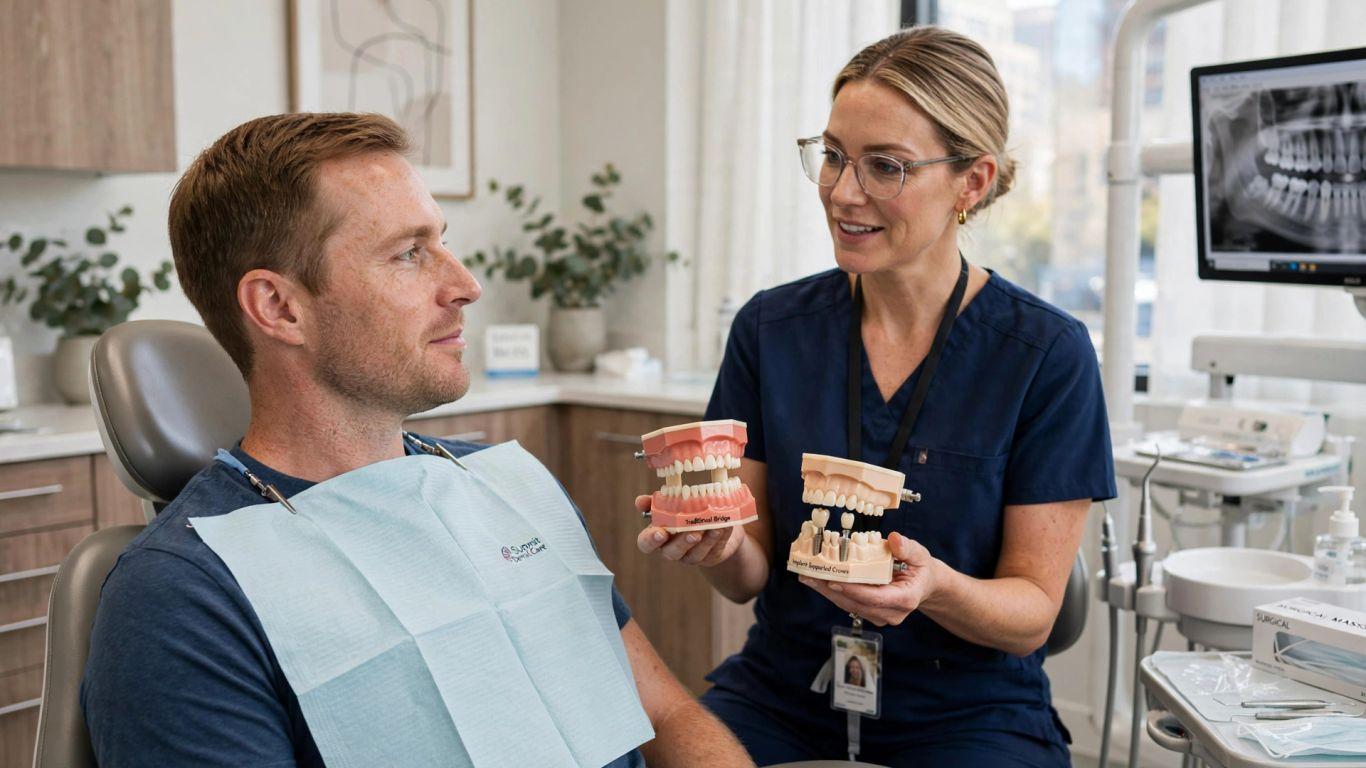
How Bridges and Implants Replace a Missing Tooth
A missing tooth can leave more than a visible gap: it may change how you bite, chew, or feel about your smile. A bridge and an implant both fill that space, but they attach to the mouth in different ways. Understanding those differences is a useful first step in weighing the dental bridge vs. implant options with your dentist. See our dental implants in Orlando page for how we approach treatment.
How a Dental Bridge Fills the Gap
A traditional dental bridge replaces the missing tooth with an artificial tooth, called a pontic, held in place by crowns fitted over the teeth beside the gap. Those neighboring teeth serve as supports, so they usually need to be reshaped to receive the crowns. The bridge is made to fit the space and blend with the surrounding teeth.
How an Implant Supports a Replacement Tooth
A dental implant is a post placed in the jawbone to support a replacement tooth, often a crown. After placement, the implant needs time to heal and bond with the surrounding bone before the final restoration is attached. An implant-supported tooth does not rely on crowns on the teeth next to the gap.
What Happens to the Jawbone and Nearby Teeth
When a tooth is lost, the jawbone in that area may gradually change because it no longer receives the same stimulation from chewing. An implant can provide stimulation through the bone where it is placed, though it cannot guarantee that bone will remain unchanged. A bridge fills the visible space but does not replace a tooth root in the gap, and its supporting teeth may need ongoing attention.
Comparing the Benefits and Trade-Offs
Neither choice is automatically best for everyone; the right fit depends on your teeth, health, priorities, and treatment plan. A bridge avoids implant surgery, while an implant requires a procedure and healing time.
Comfort, Stability, and Chewing
Both options are designed to restore function, and many people adapt to either after treatment. An implant-supported crown is anchored in the jaw, while a bridge is supported by the neighboring teeth.
| Consideration | Bridge | Implant |
|---|---|---|
| Support | Crowns on neighboring teeth | Post placed in the jawbone |
| Procedure | Tooth preparation and fitting | Surgery followed by healing |
| Adjacent teeth | Usually reshaped for support | Not used to support the replacement tooth |
| Treatment timing | Often completed without implant healing | May take longer because healing is needed |
These are general distinctions, not a prediction of how either option will feel for you. Bite, tooth location, and the condition of nearby teeth can all affect comfort and chewing.
Effects on Neighboring Teeth
A bridge depends on its supporting teeth, which are commonly reduced to make room for crowns. That can be a reasonable trade-off when those teeth already need crowns, but it means otherwise healthy teeth are altered. An implant is placed in the gap and does not use adjacent teeth as supports, although those teeth still need regular dental care.
Appearance and Speech
A well-made bridge or implant crown can be shaped and shaded to suit the surrounding teeth. Changes in speech or a feeling of fullness can occur while getting used to a replacement. If appearance or pronunciation is a concern, tell your dentist what feels most important before treatment begins.
Who May Be a Good Candidate for Each Option
Choosing between a bridge and an implant is not just a matter of preference. Your dentist will consider the missing tooth, the health of the teeth around it, your jawbone, and your general health.
When a Bridge May Make Sense
A bridge may be worth discussing when the teeth on either side of the gap already need crowns or when you prefer to avoid implant surgery. It may also suit someone for whom a longer healing process is difficult to accommodate. Our restorative dentistry services include crowns and bridges.
When an Implant May Be a Better Fit
An implant may appeal to someone who wants a replacement supported in the jaw rather than by adjacent teeth. Candidacy depends on factors such as available bone, gum health, overall health, and the ability to complete the treatment and follow-up care. Our post Are dental implants right for you? goes deeper.
How Bone Health and Medical Conditions Affect Eligibility
Bone volume and quality can affect whether an implant can be placed in a particular area. Some medical conditions, medications, and habits may also influence healing or affect the treatment plan; they do not automatically rule out an implant, but they should be discussed openly.
What to Expect During Treatment
The treatment path depends on which option you choose and on the condition of the teeth and tissues involved. A bridge typically involves preparing the supporting teeth and fitting a restoration, while an implant involves placement and a healing period.
The Steps Involved in Getting a Bridge
For a bridge, the dentist prepares the supporting teeth and takes records or scans to plan the restoration. A temporary bridge may be used while a dental laboratory makes the final one. At a later appointment, the fit and bite are checked before the bridge is secured.
Implant Surgery and Healing Time
Implant treatment begins with an assessment of the jawbone and the planned position of the replacement tooth. If appropriate, the post is placed during a procedure, then the area is given time to heal before the final crown is attached. Timing varies; some people need additional procedures or a longer healing period.
Temporary Tooth Replacement During Treatment
A temporary tooth may be an option while a permanent bridge or implant restoration is being completed. Ask how the temporary option will be secured and what foods or activities to avoid while wearing it.
Cost, Lifespan, and Ongoing Care
The total cost is shaped by more than the replacement tooth itself. The number of visits, any preparatory treatment, materials, and insurance benefits can all affect what you pay.
Comparing Upfront Costs and Insurance Coverage
An implant may have a higher initial cost than a bridge, but exact fees vary by location, treatment complexity, and what is included. Dental plans differ in how they cover bridges, implants, and related procedures, so confirm details with both the insurer and the dental office. Request a written estimate that separates the restoration from any additional treatment.
How Long Bridges and Implants May Last
Neither option has a guaranteed lifespan. A bridge may need repair or replacement if it wears, loosens, or develops problems around its supporting teeth. An implant can also need maintenance or repair, including of the crown.
Cleaning and Maintaining Each Option
Both options need consistent home care and professional checkups. These habits are useful starting points, though your dental team may recommend a routine tailored to your mouth:
- Brush twice daily with a soft-bristled toothbrush.
- Clean between teeth and around the restoration each day using tools your dentist recommends.
- Keep regular dental visits so the restoration and surrounding tissues can be checked.
- Contact your dentist if the restoration feels loose, painful, or newly uncomfortable.
How to Choose Between a Bridge and an Implant
There is no single answer that fits every missing tooth. The decision usually comes down to the condition of the neighboring teeth, the bone and gums, your health, and how you weigh cost against treatment time.
Consider the Location of the Missing Tooth
A front tooth and a back tooth have different roles in appearance and chewing, and the available space can vary from one location to another. Ask your dentist how each option would affect the specific gap and your bite.
Weigh Treatment Time Against Long-Term Goals
A bridge may be completed without waiting for an implant to heal, while implant treatment usually includes a healing stage before the final tooth is attached. If you want a faster path, ask about our Teeth Express option for suitable cases.
Questions to Discuss With Your Dentist
A comparison becomes more useful when it is tied to your own exam, health history, and priorities. For example, you might ask:
- Are the teeth beside the gap healthy enough to support a bridge?
- Is there enough bone for an implant, or would further treatment be considered?
- What are the estimated costs, insurance coverage, and possible additional fees for each option?
- How long might each treatment take, and what temporary replacement could I use?
Conclusion
A bridge and an implant can both replace a missing tooth, but they differ in how they are supported, how treatment unfolds, and what care they require. The best choice depends on your oral health, the condition of nearby teeth and bone, your timeline, and your budget. The American Dental Association's MouthHealthy overview of dental implants offers additional background. For personalised guidance, visit Fine Dentistry of Downtown Orlando or contact our office to discuss your smile goals.
Frequently Asked Questions
Is a dental bridge or implant better for one missing tooth?
Neither is universally better. The choice depends on your neighboring teeth, bone and gum health, medical history, budget, and preferences about surgery and treatment time.
Does getting a dental implant hurt?
Implant placement is performed with anesthesia, but soreness or swelling can occur afterward. Ask your dentist what to expect during recovery and how discomfort will be managed.
Does a dental bridge require surgery?
A traditional bridge generally does not require implant surgery. It does usually involve preparing the teeth next to the gap so they can support crowns.
How long does it take to get a bridge or implant?
A bridge may be completed over multiple appointments, while an implant usually includes a healing period before the final crown is attached. The timing varies with the treatment plan and your healing.
Can an implant replace a tooth if there is not enough jawbone?
Insufficient bone may affect implant placement, but the options depend on the location and your individual assessment. Your dentist can explain whether additional treatment or another restoration is appropriate.
Will dental insurance cover a bridge or an implant?
Coverage varies by plan and by the details of the treatment. Check your benefits with your insurer and ask the dental office for an estimate before beginning care.
How do I clean around a bridge or implant?
Brush twice daily and clean between teeth and around the restoration every day. A dentist or hygienist can show you suitable tools and techniques for your particular restoration.
About the Author
This article was reviewed by the dental team at Fine Dentistry of Downtown Orlando. Dr. Aileen Trivedi, DMD, FAGD, earned a Bachelor of Science in Microbiology from the University of Miami and her dental degree from Boston University, then completed a General Practice Residency at the West Palm Beach VA. She is a Fellow of the Academy of General Dentistry and an active member of the Academy of General Dentistry, the American Dental Association, and the American Academy of Cosmetic Dentistry. Fine Dentistry of Downtown Orlando is located at 429 N. Fern Creek Avenue, Orlando, FL 32803.
Disclaimer
This article is intended for general informational purposes only and does not constitute dental or medical advice. It is not a substitute for professional examination or treatment by a licensed dentist. Always consult a qualified dental professional about your specific situation.
Blog Post Author

Contributed by DentalROI
DentalROI provides relevant dental content to help providers educate patients. The statements, services, and products referenced in this article have not been evaluated by the Food and Drug Administration, and they are not intended as a substitute for professional medical advice, diagnosis, or treatment. Always seek the advice of your dental provider with any questions or issues you may have. Specific recommendations may vary in different circumstances, so individual consultation is important.